May 16, 2026
Optimization of Laser Cutting Process in Precision Sheet Metal Manufacturing: Material Adaptation and Cutting Parameter Settings from Stainless Steel to Aluminum Alloy
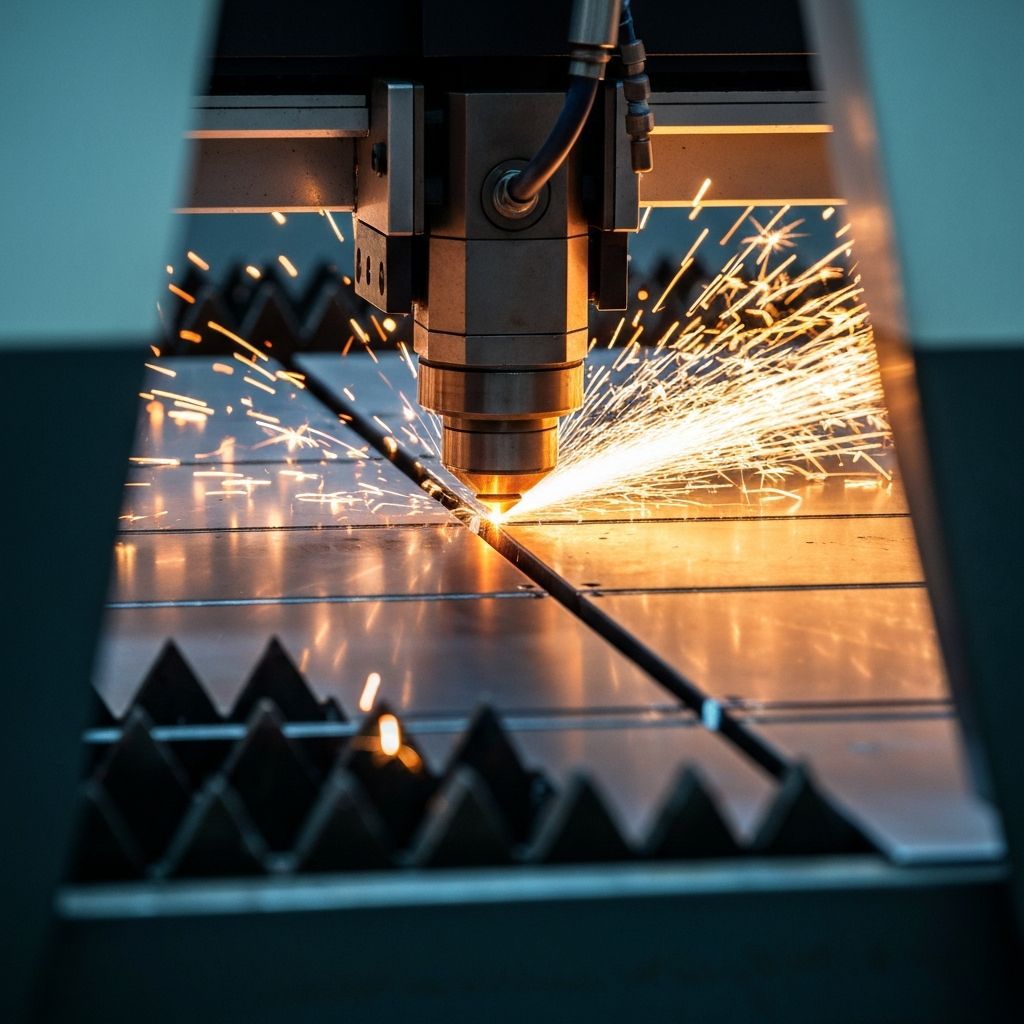
Table of Contents
1. The Core Value of Laser Cutting in Precision Sheet Metal Manufacturing
2. Stainless Steel Laser Cutting: Material Characteristics and Parameter Optimization
2.1 Material Characteristics and Cutting Difficulties of Stainless Steel
2.2 Setting and Optimization of Stainless Steel Laser Cutting Parameters
3. Aluminum Alloy Laser Cutting: Challenges and Process Adaptation
3.1 Core Challenges of Aluminum Alloy Laser Cutting
3.2 Optimization Strategies for Aluminum Alloy Laser Cutting Parameters
4. General Optimization Principles for Sheet Metal Cutting Parameters
4.1 Analysis of Key Parameters Affecting Cutting Quality
4.2 Practical Skills for Parameter Debugging
5. Quality Control and Industry Data Comparison of Precision Laser Cutting
5.1 Quality Standards for Precision Laser Cutting
5.2 Data Comparison Table of Stainless Steel and Aluminum Alloy Laser Cutting
6. Frequently Asked Questions (FAQs)
1. The Core Value of Laser Cutting in Precision Sheet Metal Manufacturing
Precision sheet metal manufacturing is the backbone of industries like aerospace, automotive, and electronics. The demand for high-precision, high-efficiency cutting processes keep growing year by year.
Laser cutting sheet metal has become the preferred technology for precision sheet metal manufacturing, thanks to its high accuracy, fast speed, and low thermal distortion. Unlike traditional cutting methods, it can handle complex shapes and thin materials with ease.
According to market research data, the global metal sheet laser cutting machine market size was about 13.38 billion yuan in 2025, and it is expected to grow steadily to nearly 18.73 billion yuan by 2032, with a CAGR of 4.9% in the next six years. This growth directly reflects the increasing reliance on laser cutting technology in precision sheet metal manufacturing.
Among all laser cutting applications, stainless steel laser cutting and aluminum alloy laser cutting are the most common. Each material has unique properties, which requires targeted optimization of sheet metal cutting parameters to achieve the best cutting effect.
2. Stainless Steel Laser Cutting: Material Characteristics and Parameter Optimization
2.1 Material Characteristics and Cutting Difficulties of Stainless Steel
Stainless steel, especially 304 stainless steel, is widely used in precision sheet metal manufacturing due to its excellent corrosion resistance, high strength, and good welding performance.
However, stainless steel has high viscosity when melted, which easily leads to dross formation and burrs on the cutting edge. These issues account for 40% of all cutting quality problems in stainless steel laser cutting.
In addition, the high thermal conductivity of stainless steel can cause excessive heat accumulation during cutting, affecting the dimensional accuracy of the finished product. This makes parameter setting crucial for stainless steel laser cutting.
2.2 Setting and Optimization of Stainless Steel Laser Cutting Parameters
The key sheet metal cutting parameters for stainless steel laser cutting include laser power, cutting speed, assist gas pressure, and focus position. Each parameter directly affects the cutting quality and efficiency.
Experimental studies have shown that for 304 stainless steel, to minimize dross formation, the optimal cutting speed is 4500 mm/min, laser power is 2500 W, and gas pressure is 9 bar. To reduce kerf taper, a cutting speed of 5500 mm/min, laser power of 3000 W, and gas pressure of 8 bar are recommended.
The focus position also plays a vital role. For thin stainless steel sheets, a positive focus position (+1 mm) is suitable; for thick sheets, a negative focus position (-1 mm) works better. The zero focus position is the standard setting for most common thicknesses.
Using nitrogen as the assist gas can effectively reduce oxidation and burrs, ensuring a smooth cutting edge. This is especially important for precision laser cutting applications that require high surface quality.
3. Aluminum Alloy Laser Cutting: Challenges and Process Adaptation
3.1 Core Challenges of Aluminum Alloy Laser Cutting
Aluminum alloy, such as 6061-T6, is another commonly used material in precision sheet metal manufacturing. It is lightweight, corrosion-resistant, and has good mechanical properties, making it ideal for aerospace and automotive parts.
However, aluminum alloy laser cutting faces unique challenges. Its high thermal conductivity leads to wide heat-affected zones and reduced cutting efficiency. The high reflectivity of aluminum alloy can reflect the laser beam back to the optical system, potentially damaging the lens and fiber optic.
In addition, aluminum alloy is highly oxidizable, and the formed aluminum oxide has high viscosity, which hinders the removal of molten metal and increases the tendency of dross formation at the cutting edge.
3.2 Optimization Strategies for Aluminum Alloy Laser Cutting Parameters
Fiber laser is the most suitable equipment for aluminum alloy laser cutting, as its short wavelength can improve the absorption rate of laser energy by aluminum alloy. Compared with CO2 laser cutting, fiber laser cutting speed is twice as fast under the same power conditions.
For 2mm thick 6061-T6 aluminum alloy, the optimal parameters are: laser power 3.5 kW, cutting speed 9 m/min, nozzle distance 1 mm, and assist gas pressure 1.1 MPa. Under these parameters, the dross height can be reduced to 20 μm, and the cutting edge is smooth with no obvious heat-affected zone.
Argon with a purity of 99.999% is recommended as the assist gas to prevent oxidation. The nozzle diameter should be 1.5 mm to ensure stable gas flow and effective dross removal. Adjusting the focus position to 0.5-1 mm can further improve cutting quality.
4. General Optimization Principles for Sheet Metal Cutting Parameters
4.1 Analysis of Key Parameters Affecting Cutting Quality
Whether it is stainless steel or aluminum alloy laser cutting, the core sheet metal cutting parameters are laser power, cutting speed, assist gas, and focus position. These parameters are interdependent and need to be adjusted according to the material and thickness.
Laser power directly determines the energy input. Too low power will lead to incomplete penetration, while too high power will cause over-melting and excessive dross. Incomplete penetration accounts for 10% of cutting quality problems, mainly caused by insufficient power or improper focus position.
Cutting speed affects production efficiency and cutting quality. Too fast speed will result in burrs and incomplete cutting; too slow speed will increase heat accumulation and thermal distortion. Assist gas pressure and type affect dross removal and oxidation control, with insufficient gas pressure being a major cause of burrs and dross.
4.2 Practical Skills for Parameter Debugging
When debugging sheet metal cutting parameters, start with the recommended parameters based on material and thickness, then adjust step by step. It is best to test with small samples first to avoid material waste.
If burrs appear, first check the focus position and gas pressure. Adjusting the focus position by ±0.5 mm or increasing the gas pressure by 1-2 bar can often solve the problem. If dross is excessive, reduce the cutting speed by 15-20% or replace the worn nozzle.
For precision laser cutting, regular calibration of the laser focus and nozzle position is necessary. This ensures consistent cutting accuracy and reduces the need for subsequent finishing processes.
5. Quality Control and Industry Data Comparison of Precision Laser Cutting
5.1 Quality Standards for Precision Laser Cutting
The quality of precision laser cutting is evaluated by cutting accuracy, surface roughness, and dross formation. The standard cutting accuracy for precision sheet metal laser cutting is ±0.05 mm, and the surface roughness Ra should be less than 1.6 μm.
According to AWS standards, the heat-affected zone width for laser cutting of stainless steel and aluminum alloy should not exceed 0.3 mm, and there should be no obvious cracks or deformation on the cutting edge.
5.2 Data Comparison Table of Stainless Steel and Aluminum Alloy Laser Cutting
Material (Thickness) | Laser Power | Cutting Speed | Assist Gas (Pressure) | Focus Position | Dross Height | Cutting Accuracy |
304 Stainless Steel (2mm) | 2500-3000 W | 4500-5500 mm/min | Nitrogen (8-9 bar) | 0 to -1 mm | ≤0.1 mm | ±0.05 mm |
6061 Aluminum Alloy (2mm) | 3000-3500 W | 6-9 m/min | Argon (0.9-1.1 MPa) | 0.5-1 mm | ≤0.02 mm | ±0.06 mm |
6. Frequently Asked Questions (FAQs)
Q1: Why do burrs appear in stainless steel laser cutting?
A1: The main reasons are incorrect focus position (accounting for 40% of cases), insufficient assist gas pressure (30%), too high cutting speed (20%), or worn nozzles (10%). Adjusting the focus position, increasing gas pressure, or reducing cutting speed can solve the problem.
Q2: How to avoid damage to the optical system during aluminum alloy laser cutting?
A2: Aluminum alloy has high reflectivity, so it is necessary to use fiber laser with short wavelength, which can reduce reflection. In addition, adjusting the focus position and using anti-reflection lenses can also protect the optical system from damage.
Q3: What is the difference between fiber laser cutting and CO2 laser cutting for aluminum alloy?
A3: Fiber laser has higher energy absorption rate for aluminum alloy. Under the same laser power, the cutting speed of fiber laser is twice that of CO2 laser, and the cutting quality is better with narrower heat-affected zone.
Q4: How to determine the optimal sheet metal cutting parameters for different material thicknesses?
A4: Start with the recommended parameters provided by the equipment manufacturer, then conduct small-sample tests. Adjust laser power and cutting speed according to the cutting effect, and fine-tune the assist gas pressure and focus position to achieve the best results.
Q5: What assist gas is suitable for precision laser cutting of stainless steel and aluminum alloy?
A5: Nitrogen is recommended for stainless steel to prevent oxidation and reduce burrs. Argon with high purity (99.999%) is suitable for aluminum alloy to avoid oxidation and ensure smooth cutting edge.
Related articles
May 16, 2026
Calculation of the bearing capacity of non-standard sheet metal equipment frames: mechanical analysis from material selection to structural optimization to welding process
May 16, 2026
Woven Labels vs Printed Labels: Which Is Better for B2B Apparel Manufacturers & Suppliers?
Woven Labels vs Printed Labels: Which Is Better for B2B Apparel Manufacturers & Suppliers?
May 14, 2026
The Advantages of Laser Cutting: Why It’s the Preferred Choice for Modern Industrial Manufacturing
The Advantages of Laser Cutting: Why It’s the Preferred Choice for Modern Industrial Manufacturing
May 19, 2026
Machining the Impossible: Tips for High-Precision Titanium and Inconel Parts
Machining the Impossible: Tips for High-Precision Titanium and Inconel Parts
May 11, 2026
High-Precision CNC Machining | High-Tolerance Components for Aerospace & Medical Applications
High-Precision CNC Machining | High-Tolerance Components for Aerospace & Medical Applications