November 5, 2026
Sheet Metal Welding Before Powder Coating for Better Finishes
A smooth powder finish starts before powder reaches the part. Weld spatter, open pores and distorted panels can remain visible after coating, while contamination can interfere with adhesion.
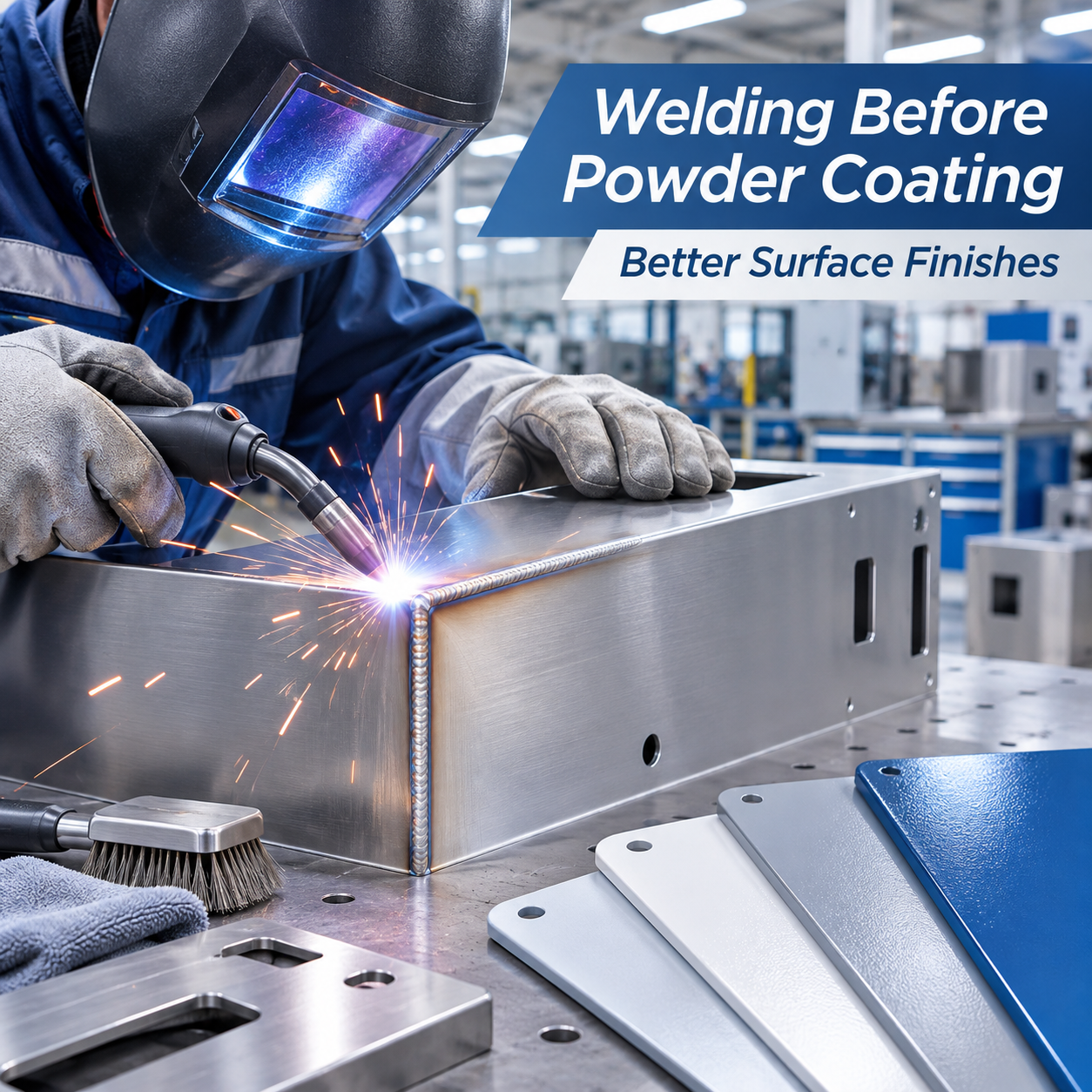
A smooth powder finish starts before powder reaches the part. Weld spatter, open pores and distorted panels can remain visible after coating, while contamination can interfere with adhesion.
For sheet metal welding before powder coating, the useful question is whether the fabrication is ready for finishing. At HDT, our fabrication services include welding alongside cutting and bending. We recommend defining weld acceptance, surface preparation and cosmetic expectations together when specifying coated components, especially where a visible seam sits beside a mounting or sealing surface.
Contents
Control heat without compromising the joint
Inspect welds before surface finishing
Prepare seams for powder application
Match defects to preventive controls
Separate welding from powder operations
A documented lesson from a coating workshop
Agree the coated part specification
Powder coating buyer questions
Review your welded component
Control heat without compromising the joint
Thin panels have limited resistance to movement during welding. As heated metal expands and then contracts, the part can pull away from its intended shape. Thin sheet metal welding therefore needs a suitable joint design, controlled heat input and an installation arrangement that supports dimensional accuracy.
Material grade, thickness and joint access affect process selection. CO2 shielded welding can be suitable for some steel fabrications, but it is not a blanket recommendation for every precision component. Aluminium, stainless steel and different appearance requirements may call for other combinations of process, filler and shielding gas.
Plan the sequence along the seam
TWI guidance on distortion control describes back-step and skip welding as ways of sequencing short weld lengths. These approaches distribute welding activity along the joint instead of completing a long seam continuously in one direction.
Sequence and final weld coverage are separate decisions. An intermittent finished weld leaves gaps and is acceptable only where the design permits them. Do not replace a specified continuous or sealed joint simply to reduce distortion.
For welding distortion control, assess the part after welding against its drawing. A panel that has to be forced into an assembly may transfer the problem into door alignment, adjacent components or sealing interfaces. Cosmetic approval cannot replace dimensional acceptance.
Inspect welds before surface finishing
Powder coating does not repair an unacceptable weld. Check the joint before grinding or finishing makes its original condition harder to assess. The inspection scope should reflect the material, service conditions and specified weld acceptance criteria.
Porosity is gas trapped as cavities in solidifying weld metal. TWI explains that contamination and inadequate gas shielding can contribute to it. Surface-breaking pores matter to appearance, but a visually tidy surface alone does not establish the internal quality of a joint.
Lack of fusion means the weld has not properly joined the intended surfaces. Slag inclusions can arise in processes using flux. Different processes produce different risks, so an inspection checklist should match the actual welding method rather than list every possible defect without context.
Repair the cause before hiding the surface
Where a weld fails its acceptance requirements, use an approved repair route and inspect it again before coating. Grinding over an opening does not establish that the underlying discontinuity has been removed. Buyers should agree when repairs require approval and what records accompany the finished components.
Prepare seams for powder application
Weld spatter removal and weld seam finishing should leave the surface suitable for the specified coating. Remove loose residues and sharp projections without cutting into the parent material or reducing the weld below its required size. Flush grinding is an appearance requirement that needs design agreement, not an automatic instruction for every seam.
Sheet metal surface preparation also includes removing contaminants that interfere with pretreatment and coating. Pay attention to recesses, overlaps and corners where residues can remain. Any anti-spatter product used during fabrication should be compatible with the subsequent cleaning and finishing route.
Coating thickness cannot compensate for poor preparation. An uneven seam can produce an uneven appearance, while cavities may remain visible as pinholes or craters. However, a coating defect is not proof of one particular welding fault; substrate condition, contamination and the coating process all need examination.
Define the finish where function depends on it
Agree which threads, mounting faces, contact areas and other features require masking. A powder layer changes the finished surface, so fitting requirements should be considered before coating. Use the specified coating system and its processing instructions; cure conditions must suit the product and part rather than an assumed universal oven setting.
Match defects to preventive controls
A shared defect checklist helps buyers distinguish weld quality from coating appearance. Each issue needs a check at the stage where it can be corrected effectively.
Observed issue | Fabrication or finishing check | Agreed acceptance basis |
Panel bow or uneven fit | Heat input, restraint and weld sequence | Finished dimensions and alignment |
Open pores along a seam | Joint cleanliness and gas shielding | Specified weld quality and appearance |
Projections beneath the finish | Spatter and residue removal | Surface condition before coating |
Visible grinding troughs | Grinding depth and seam profile | Required weld size and cosmetic finish |
Coating problems near overlaps | Cleaning access and retained residues | Approved pretreatment and coating tests |
Coated threads or contact faces | Masking plan and post-coating checks | Drawing requirements for those features |
Powder coating adhesion and cosmetic quality should be assessed through the agreed inspection plan. Where adhesion testing is required, define the method and acceptance level.
Separate welding from powder operations
Welding sparks and arcs must be kept away from coating powder and accumulated dust. The UK Health and Safety Executive identifies dust accumulation and ignition sources as fire and explosion concerns in powder coating work areas.
Hot work near powder coating requires assessment of the actual installation, including adjacent areas and dust collection equipment. Separate the operations and control powder deposits and ignition sources. A cleared patch of floor does not establish that nearby ducts, collectors or concealed surfaces are safe.
Competent personnel should manage the relevant work authorization, ventilation, fire precautions and protective equipment. Verify operator qualifications and applicable local requirements. A permit documents controls; it does not replace the checks needed to establish safe conditions before work starts.
A documented lesson from a coating workshop
An HSE prosecution published on 22 November 2023 concerned W.S. Barrett and Son Limited, a UK manufacturer. An inspection had found potential exposure to welding fume and powder coating dust. Extraction equipment was poorly maintained, and local exhaust ventilation systems had not received the required thorough examination and testing.
The company was fined GBP 10,000 and ordered to pay GBP 3,625.20 in costs. The published HSE case demonstrates why the presence of extraction equipment is insufficient without maintenance and verification of its performance.
For buyers reviewing a fabrication and finishing route, the practical lesson is to ask how welding fume and coating dust are controlled through their respective operations.
Agree the coated part specification
A useful quotation enquiry should identify the base metal, sheet thickness, joint requirements and intended service environment. Include drawings showing visible surfaces, masked features and any areas where continuous welds or leak resistance are required.
Before releasing production, confirm:
· Whether seams need flush finishing or may retain an approved weld profile.
· The coating system, colour, texture and specified thickness requirements.
· The dimensional checks required after welding and after coating.
· Inspection methods for adhesion, appearance and any specified corrosion performance.
· How repaired welds and coating touch-ups will be reviewed.
For a new design, approve a representative finished part or sample before committing the batch. Record the agreed appearance clearly enough that later deliveries can be assessed consistently. Acceptance should cover the function of the component as well as what a visitor sees on its outside face.
Powder coating buyer questions
Can powder hide small weld pores
Do not depend on it. Surface openings may remain visible, and coating cannot restore weld integrity. Inspect and resolve unacceptable weld discontinuities before finishing.
Must every welded seam be ground flat
No. Grinding depends on appearance, fit and the required joint geometry. Removing too much metal can weaken the joint. Specify flush seams only where the design allows the required finishing.
Is one welding process best for all coated sheet metal
No. Select the process for the material, joint and production requirements. Coating quality also depends on cleaning, pretreatment and cure, so process choice alone cannot guarantee the finished result.
Can a coated part be welded again
Further welding requires an approved repair plan, suitable coating removal and exposure controls, followed by inspection and restoration of the finish. It should not be treated as an ordinary finishing touch inside an operating powder area.
Review your welded component
Better sheet metal welding before powder coating comes from controlling the joint, preparing the surface and keeping incompatible operations safely separated. Share your drawings and finish requirements with HDT so we can discuss the fabrication route, visible seams and inspection points before production begins.