October 10, 2026
Sheet Metal Cutting Methods and Operator Qualification Requirements
Sheet Metal Cutting Methods determine how a flat blank is produced, which features can be created in the same setup, how much tooling is required and which safety controls operators must follow.
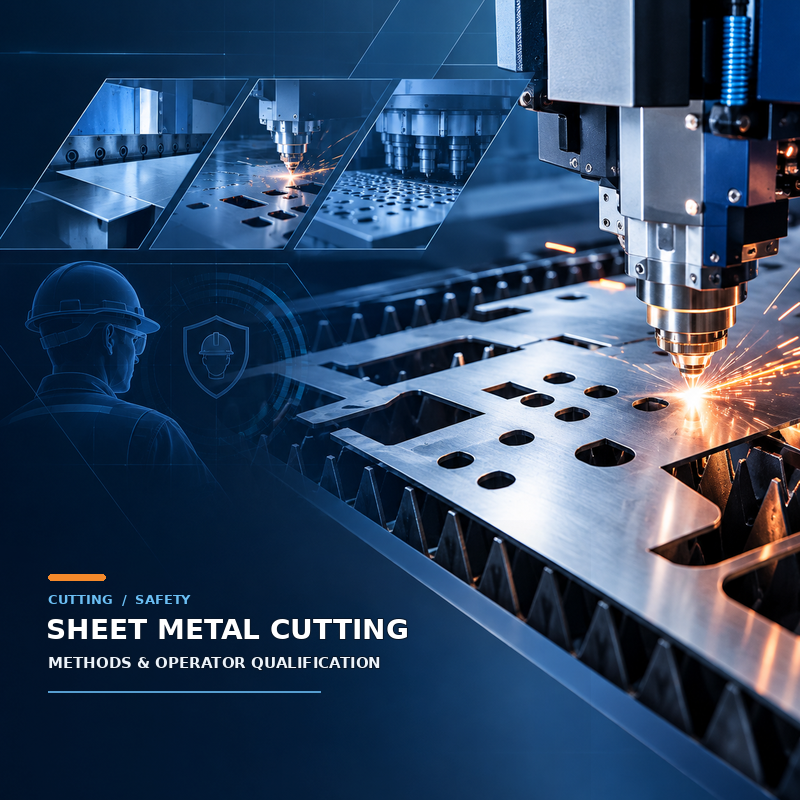
Sheet Metal Cutting Methods determine how a flat blank is produced, which features can be created in the same setup, how much tooling is required and which safety controls operators must follow. Shearing, laser cutting and punching all remove or separate material, but they do not offer the same geometry, setup economics or forming capability. The phrase CNC cutting describes a control method rather than one single physical process, so buyers should always identify the equipment behind the term.
HDT Technology provides sheet metal fabrication services that include 6000W fiber laser cutting, CNC press brake bending, welding and finishing. The company publicly lists a laser cutting thickness range of 0.5 to 30 millimetres, while actual capacity depends on material, grade, geometry and acceptance requirements. Using the customer's original technical notes as the foundation, this article compares the main cutting routes and explains why operator requirements must be assigned by job and equipment rather than by one universal certificate.
Cutting Route and Workforce Requirement Guide
• Shearing Provides an Economical Route for Straight Blanks
• Laser Cutting Handles Complex Profiles Without a Dedicated Die
• Punching Combines Fast Holemaking With Formed Features
• CNC Cutting Must Name the Machine and Physical Process
• Process Selection Should Consider the Entire Manufacturing Route
• Safety Requirements Differ Between Laser Punch and Shear Work
• Job Competence Is Broader Than Possessing One Certificate
• Special Operations Require Formal Training and Authorization
• Training Records Should Connect People Equipment and Revision
• HDT Connects Cutting Capability With Downstream Fabrication
• A Technical RFQ Makes Cutting Proposals Comparable
• Buyer Questions About Cutting Routes and Personnel Requirements
Shearing Provides an Economical Route for Straight Blanks
A guillotine shear separates sheet along a straight line using upper and lower blades. It is efficient for strips, rectangles and simple blocks that will move to punching or forming. Tooling cost is low, programming is limited and cycle time can be short. For a repetitive rectangular blank, shearing may be more economical than using a high-value laser simply because the required geometry is uncomplicated.
The limitation is feature freedom. A shear does not create internal holes, corners or complex curves, and cut quality depends on blade clearance, sharpness, material thickness and machine condition. Edge rollover, burnish, fracture and burr should be considered if the blank becomes a visible or functional edge. Squareness and length tolerance must be matched to the downstream forming and trimming plan.
Laser Cutting Handles Complex Profiles Without a Dedicated Die
A fiber laser concentrates energy into a small area and follows a programmed path. It can produce irregular contours, slots and dense hole layouts without a dedicated hard tool. This flexibility suits prototypes, product variants and small or medium batches where the drawing may change. Nesting software can arrange different components on the same sheet, although material utilization still depends on part geometry, grain direction and required spacing.
The customer's original material identifies a typical precision level of approximately plus or minus 0.1 millimetres for suitable work. That value should remain a planning reference, not an unconditional guarantee. Material type, thickness, feature size, thermal behavior, machine setup and measurement method affect the achievable result. Buyers should place critical tolerances on the drawing and review very small holes, narrow webs and heat-sensitive edges before release.
Punching Combines Fast Holemaking With Formed Features
A mechanical or CNC turret punch drives selected tools through the sheet. With suitable dies, it can create holes, slots, ventilation patterns and repeated edge features efficiently. It can also form louvers, embosses and flanged holes, which is an important advantage over a flat laser-cut profile. For stable high-volume products, a punch or dedicated stamping die can reduce cycle time.
Punching requires compatible tooling and enough clearance between features, sheet edges and formed areas. Tool wear can change burr height and hole quality. Dense patterns may distort the panel. The original technical note gives a general punching precision range of approximately plus or minus 0.1 to 0.2 millimetres; the project specification should confirm actual tolerance according to feature, material and tooling rather than applying one value to every dimension.
CNC Cutting Must Name the Machine and Physical Process
CNC means that programmed numerical instructions control machine movement or tool selection. A CNC turret punch and a CNC laser are both CNC machines, yet they remove material in different ways and offer different formed-feature capabilities. Treating CNC cutting as a fourth physical category beside punching and laser cutting creates conceptual overlap.
A clear quotation should say CNC turret punching, CNC laser cutting, CNC shearing or another specific process. This language tells the buyer whether dedicated tools are involved, whether formed features are possible and which edge condition to expect. It also helps the safety plan identify optical radiation, mechanical pinch points, noise, fumes, electrical systems and material-handling risks associated with the actual equipment.
Cutting route | Geometry and features | Economic fit | Typical planning tolerance | Main operator focus |
Guillotine shearing | Straight strips and rectangular blanks | Simple repetitive parts and low tooling cost | Defined by machine material and downstream need | Blade clearance guarding and sheet support |
Fiber laser cutting | Complex contours holes and mixed nests | High mix low to medium volume and revisions | Around ±0.1 mm only where conditions support it | Laser enclosure optics fumes and fire control |
CNC turret punching | Holes patterns louvers embosses and flanges | Repeat features and medium to high volume | Often around ±0.1 to ±0.2 mm by feature | Tooling pinch points noise and sheet movement |
Dedicated die blanking | One stroke outer profile or repeated feature set | Stable high volume that justifies tooling | Set by die condition press and material | Die setup press safety and maintenance |
Hybrid process route | Laser profile plus punched or formed features | Parts needing flexibility and three dimensional details | Controlled across datum transfers | Program revision part identity and handoff |
Process Selection Should Consider the Entire Manufacturing Route
Cutting cost is only one part of the decision. A laser may create a complex blank quickly, but a secondary operation may still be needed for louvers or flanged holes. A turret punch can combine several formed features but may leave nibble marks on long curved edges. Shearing is economical for straight blanks but cannot complete internal details. Dedicated dies deliver speed after tooling is proven, yet engineering changes can make that investment obsolete.
The best route considers quantity, revision stability, material, feature type, edge requirement, forming sequence and inspection. A hybrid route is often practical: shear master blanks, laser-cut complex profiles, punch formed features, then bend and weld. The supplier should identify datum transfer between operations so accumulated variation remains within the final assembly requirement.
Safety Requirements Differ Between Laser Punch and Shear Work
Guillotine shears and presses create crushing, cutting and pinch hazards. Controls include guarding, interlocks, safe setup procedures, suitable material support and lockout practices for maintenance. Turret punches add programmed movement, automatic tool changes, sheet repositioning and noise. Operators need to understand the machine's protected area and the consequences of reaching into equipment before stored energy is controlled.
Laser cutting adds optical radiation, fumes, hot material and fire risk. GB 9448-2025, Safety in Welding and Cutting, took effect on 1 August 2026 and expands requirements relevant to modern processes, including laser and laser-arc operations. The standard supports risk identification, operating procedures, training and appropriate protective measures. Personal protective equipment must match the real exposure; protective eyewear alone does not replace enclosure and engineering controls.
Job Competence Is Broader Than Possessing One Certificate
China's national occupational skill standards for stamping workers cover operation of stamping, sheet metal, bending and rolling equipment through progressive skill levels. Entry-level personnel are expected to understand basic drawings and equipment operation, while higher levels require stronger process knowledge, troubleshooting and technical responsibility. Similar metalworking skills can also relate to fitter standards depending on the assigned work.
A factory should translate these broad standards into a job matrix. A laser operator needs equipment startup, program verification, material identification, nozzle and optical checks, safe unloading and alarm response. A press brake operator needs tooling selection, bend sequence, angle correction and pinch-point awareness. A setup technician or supervisor requires additional authority and competence. Qualification should match the task actually performed.
Special Operations Require Formal Training and Authorization
The revised Chinese Regulations on Safety Technical Training and Assessment of Special Operations Personnel, issued as Ministry of Emergency Management Order No. 19, took effect on 1 June 2026. Covered special-operations personnel must satisfy the applicable age and health conditions, receive required safety-technical training, pass assessment and hold a valid operation certificate before working. The regulation applies to work included in the formal special-operation catalogue.
Laser cutting is not automatically treated as every traditional special-operation category, but employers remain responsible for safe procedures, risk assessment and training under the relevant equipment and process requirements. Welding, electrical work, lifting or other tasks connected with a fabrication line may have separate authorization needs. The correct conclusion is therefore job-specific and equipment-specific, not that every sheet metal employee needs the same certificate.
Training Records Should Connect People Equipment and Revision
A practical competence record identifies the operator, equipment model, authorized task, training content, assessment result and validity or review date. It should also distinguish normal production, setup, maintenance and troubleshooting authority. When software, tooling, material range or guarding changes, the company should decide whether additional instruction or reassessment is required.
Program control is part of safe and accurate work. Operators need to verify drawing revision, material and sheet thickness before loading. The first part should be checked for profile, hole position and edge condition. A released CNC program should not be overwritten casually on the machine. Revision discipline protects both product quality and the operator from unexpected motion or an incorrect cutting sequence.
HDT Connects Cutting Capability With Downstream Fabrication
HDT Technology's public capabilities connect laser cutting with CNC bending, MIG, TIG and spot welding, finishing and mechanical assembly. This integration matters because a blank is valuable only when it continues successfully through the next operations. Bend deductions, weld access, fastener clearance and coating protection should be considered before nesting and cutting.
For custom projects, our team reviews the drawing, material, thickness, quantity, critical dimensions, surface requirements and destination. We do not treat a general website capacity as a promise for every geometry. Final feasibility and tolerance depend on the submitted design, material condition, process route and inspection plan.
A Technical RFQ Makes Cutting Proposals Comparable
Provide the latest 2D drawing and a neutral 3D model when available. State material grade, thickness, quantity, revision, flatness, edge requirement and any features that will be formed in the punch. Identify cosmetic faces and grain direction. If the buyer proposes a method, explain whether it is mandatory or whether the supplier may recommend an alternative route.
Ask each supplier to identify the actual cutting process, tooling requirement, tolerance assumptions, secondary operations, inspection method and operator-safety considerations relevant to the equipment. A precise RFQ does not force every part onto one technology. It creates a common basis for selecting a method that is technically appropriate, commercially realistic and manageable in production.
Buyer Questions About Cutting Routes and Personnel Requirements
Is laser cutting always more accurate than punching?
Not in every feature or production condition. Accuracy depends on material, thickness, tool or beam condition, geometry, setup and measurement. Both processes can be precise when correctly selected and controlled.
Why is CNC cutting not a complete process description?
CNC identifies programmed control. The machine may be a laser, turret punch, shear or another system, so the physical cutting method must also be named.
Do all sheet metal operators need a special operation certificate?
No single rule covers every role. Formal certification depends on whether the assigned work is included in the applicable special-operation catalogue. Every operator still needs equipment-specific training and authorization.
What records should a buyer request for regulated work?
Define the required operator or procedure qualifications, certificate validity, inspection records and traceability before quotation. Requirements vary by process, jurisdiction and product risk.
Send HDT Technology your drawings, material, quantities and critical features to compare shearing, laser cutting, punching or a combined production route. We can review the cutting decision together with bending, joining, finishing and inspection requirements.