September 21, 2026
Medical Equipment Enclosure Design: Supporting Reliable Medical Device Operation and Lifecycle Management
Modern medical equipment is becoming increasingly intelligent and complex. Diagnostic systems, laboratory equipment, imaging devices, monitoring systems, and treatment equipment now combine precision mechanics, electronic control systems, sensors, communication modules, and advanced software.
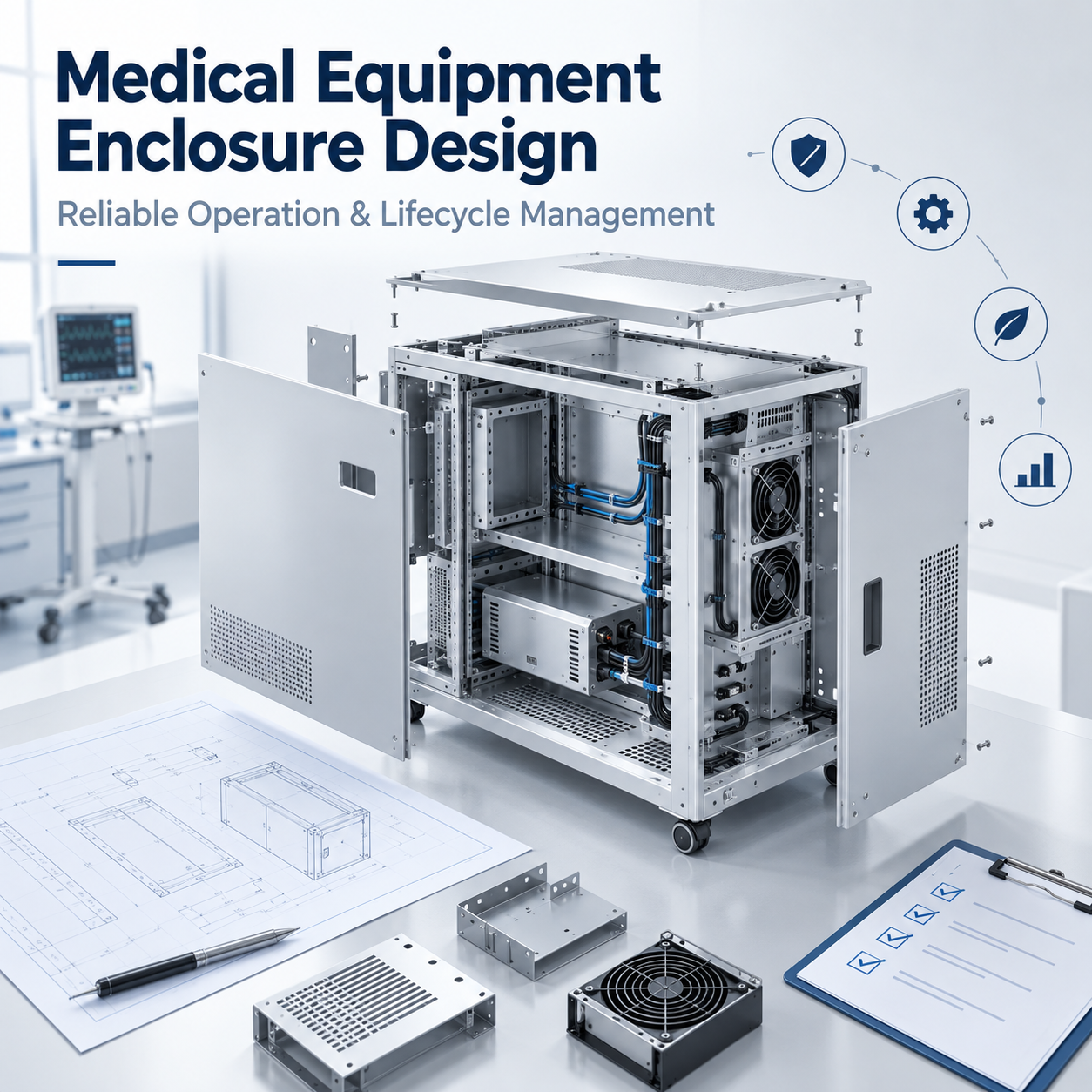
Introduction
Modern medical equipment is becoming increasingly intelligent and complex.
Diagnostic systems, laboratory equipment, imaging devices, monitoring systems, and treatment equipment now combine precision mechanics, electronic control systems, sensors, communication modules, and advanced software.
However, behind these technologies is a fundamental requirement that cannot be ignored: the equipment must operate safely and reliably throughout its service life.
This is why Medical Equipment Enclosure Design has become an important part of medical device manufacturing.
An enclosure is not simply an external cover.
It protects sensitive components, supports internal assemblies, helps manage heat dissipation, improves maintenance efficiency, and influences the overall user experience.
As hospitals and healthcare organizations place greater emphasis on equipment reliability, preventive maintenance, and lifecycle management, medical device manufacturers are paying more attention to enclosure structures, cabinet design, and manufacturing quality.
Table of Contents
· Why Medical Equipment Lifecycle Management Matters
· The Role of Enclosures in Medical Device Reliability
· Key Requirements for Medical Equipment Cabinet Manufacturing
· Design Considerations for Medical Device Housings
· Cleanability and Surface Requirements
· Thermal Management and Ventilation Design
· Maintenance-Friendly Structural Design
· Modular Design Supports Future Upgrades
· Smart Manufacturing and Medical Equipment Development
· Traditional vs Modern Medical Equipment Enclosure Design
· How Sheet Metal Suppliers Support Medical Device Manufacturers
· Frequently Asked Questions
· Conclusion
Why Medical Equipment Lifecycle Management Matters
Medical equipment is usually a long-term investment.
Unlike ordinary consumer products, many medical devices operate continuously in professional environments where reliability directly affects daily healthcare activities.
A complete equipment lifecycle includes:
· Product design
· Manufacturing
· Installation
· Daily operation
· Preventive maintenance
· Repair
· Upgrade
· Final replacement
Every stage depends on equipment reliability.
According to the original customer material, medical equipment operation and maintenance management must consider several important characteristics, including reliability, safety, economy, and information-based management.
While software systems and digital platforms improve equipment monitoring and management, the physical structure of the equipment remains the foundation.
A poorly designed enclosure can create problems with:
· Component protection
· Heat dissipation
· Cleaning
· Repair access
· Structural stability
Therefore, enclosure design should be considered part of the complete medical equipment lifecycle strategy.
The Role of Enclosures in Medical Device Reliability
Medical equipment enclosures perform multiple functions simultaneously.
Protection of Internal Components
Modern medical devices contain sensitive electronics, sensors, motors, control systems, and precision mechanisms.
The enclosure helps protect these components from:
· Dust
· Accidental impact
· Environmental contamination
· Mechanical damage
A properly designed housing creates a stable operating environment for internal systems.
Structural Support
Many medical devices contain heavy modules or precision mechanisms.
The enclosure and internal frame may need to support:
· Electronic components
· Displays
· Moving assemblies
· Power systems
· Control modules
Insufficient structural design can lead to vibration, deformation, or assembly difficulties.
Maintenance Accessibility
Medical equipment requires regular inspection, cleaning, calibration, and repair.
A good enclosure design should consider:
· Easy panel removal
· Convenient access points
· Clear internal layout
· Safe cable routing
· Replaceable modules
Poor accessibility increases maintenance time and may affect equipment availability.
Key Requirements for Medical Equipment Cabinet Manufacturing
Compared with ordinary industrial cabinets, medical equipment cabinets usually have higher requirements.
Important factors include:
· Dimensional accuracy
· Structural strength
· Surface quality
· Cleanability
· Corrosion resistance
· Thermal management
· Assembly consistency
A professional Medical Equipment Cabinet Manufacturer needs to understand not only metal processing but also the functional requirements of medical equipment.
Design Considerations for Medical Device Housings
Medical device housing design requires balancing several factors.
Precision and Assembly Accuracy
Medical equipment often contains multiple interconnected modules.
The enclosure must accurately match:
· Electronic components
· Mechanical assemblies
· Displays
· Sensors
· Internal brackets
Incorrect mounting positions can increase assembly difficulty and create future maintenance problems.
Precision manufacturing processes such as laser cutting, CNC bending, welding control, and dimensional inspection help maintain consistency.
Structural Strength
A medical device may need to withstand:
· Transportation
· Daily operation
· Repeated cleaning
· Mechanical vibration
· Long-term use
The design should provide enough rigidity while avoiding unnecessary weight.
Material thickness, reinforcement structures, and welding methods all influence final performance.
Cleanability and Surface Requirements
Healthcare environments place strong emphasis on cleanliness.
The enclosure surface should support easy cleaning and maintenance.
Important considerations include:
· Smooth surfaces
· Reduced dirt accumulation areas
· Suitable surface coatings
· Corrosion resistance
· Easy access to external surfaces
Stainless steel is often selected for applications requiring strong corrosion resistance and cleaning performance.
Other materials, such as aluminum alloys or coated steel, may also be suitable depending on the equipment environment.
The correct choice depends on actual requirements rather than simply selecting the most expensive material.
Thermal Management and Ventilation Design
Modern medical equipment often contains increasingly powerful electronic systems.
More functions mean more attention must be paid to heat management.
A good enclosure design should consider:
· Airflow paths
· Ventilation openings
· Fan locations
· Internal component arrangement
· Heat-generating components
Poor ventilation can increase internal temperature and affect component lifespan.
At the same time, ventilation design must balance cooling requirements with protection against dust and contamination.
This requires cooperation between equipment designers and enclosure manufacturers.
Maintenance-Friendly Structural Design
Medical equipment maintenance is not only about repairing failures.
Preventive maintenance helps extend service life and improve equipment availability.
Therefore, enclosure structures should support efficient maintenance.
Examples include:
· Removable panels
· Standard fasteners
· Organized cable access
· Modular internal structures
· Clearly positioned service areas
A well-designed housing allows technicians to complete inspections and repairs faster.
This reduces downtime and improves the overall operating efficiency of medical equipment.
Modular Design Supports Future Upgrades
Medical technology changes quickly.
Equipment manufacturers may need to update:
· Control systems
· Electronic modules
· Sensors
· Communication components
A rigid, difficult-to-modify enclosure can limit future upgrades.
Modern Medical Device Housing Solutions increasingly consider modularity.
Examples include:
· Replaceable panels
· Adjustable mounting structures
· Standardized internal supports
· Expandable cabinet designs
Modular structures allow manufacturers to update equipment without completely redesigning the entire product.
This is especially valuable for professional medical equipment with long service cycles.
Smart Manufacturing and Medical Equipment Development
The medical equipment industry is also influenced by the wider trend toward smart manufacturing.
Digital design, automated processing, and production traceability help manufacturers improve consistency.
For enclosure suppliers, smart manufacturing can support:
· Faster design changes
· Better production tracking
· More stable quality
· Improved repeatability
· Easier documentation
Processes such as:
· CNC laser cutting
· Automated bending
· Precision welding
· Digital inspection
allow manufacturers to produce complex structures more efficiently.
For medical device companies developing multiple product models, flexible manufacturing capability becomes increasingly important.
Traditional vs Modern Medical Equipment Enclosure Design
Design Area | Traditional Equipment Housing | Modern Medical Equipment Enclosure |
Main Purpose | Basic protection | Protection, maintenance and performance support |
Structure | Fixed design | Modular and upgrade-friendly |
Manufacturing | General fabrication methods | Precision digital manufacturing |
Maintenance | Limited access consideration | Designed for inspection and repair |
Cooling | Basic ventilation | Optimized airflow management |
Surface | Appearance-focused | Cleanability and durability focused |
Production | Larger standard production | Flexible customized manufacturing |
This shift shows that medical equipment enclosures are becoming active parts of equipment performance rather than passive covers.
Challenges in Medical Equipment Enclosure Manufacturing
Although demand is growing, manufacturers also face challenges.
Balancing Precision and Cost
Medical equipment requires high quality, but manufacturers must also control production costs.
The challenge is finding the correct balance between:
· Material selection
· Manufacturing process
· Structural requirements
· Production volume
Supporting Customized Products
Medical equipment manufacturers often develop specialized systems.
This means suppliers need to handle:
· Different designs
· Small batches
· Frequent engineering communication
· Short development cycles
Maintaining Consistent Quality
Medical applications require stable quality.
Small differences between batches can create assembly problems.
Reliable process control and inspection systems are therefore essential.
How Sheet Metal Suppliers Support Medical Device Manufacturers
A capable supplier should provide more than fabrication.
The most valuable partners can support:
Engineering Collaboration
Review designs and suggest improvements before production.
Manufacturing Integration
Combine cutting, bending, welding, machining, finishing, and inspection.
Flexible Production
Support prototypes, small batches, and future product upgrades.
Quality Management
Maintain consistent processes and production records.
For medical equipment manufacturers, this reduces supply chain complexity and improves product development efficiency.
What This Means for Hongdingtian
Hongdingtian (Suzhou) Intelligent Technology Co., Ltd. provides precision manufacturing capabilities including sheet metal fabrication, machining, and customized equipment structures.
For medical equipment applications, these capabilities support products requiring:
· Precision-cut panels
· Equipment housings
· Electrical cabinets
· Structural frames
· Internal mounting components
· Customized metal assemblies
Modern medical equipment requires cooperation between designers, equipment manufacturers, and component suppliers.
A reliable enclosure partner can help transform a product design into a stable, manufacturable solution.
Frequently Asked Questions
Why is medical equipment enclosure design important?
Medical equipment enclosures protect internal components, support structural stability, improve maintenance access, and contribute to thermal management and equipment reliability.
What materials are commonly used for medical equipment housings?
Common materials include stainless steel, aluminum alloy, cold-rolled steel, and coated metal sheets. The best choice depends on cleanliness requirements, strength, corrosion resistance, and application conditions.
How does enclosure design affect medical equipment maintenance?
Good enclosure design provides easier access, organized internal layouts, removable panels, and better serviceability, reducing maintenance time and equipment downtime.
Why do medical device manufacturers need customized enclosure suppliers?
Medical equipment often has unique structures and small-to-medium production volumes. Customized suppliers can provide flexible manufacturing support and engineering collaboration.
Conclusion
Medical equipment lifecycle management is not only about software systems, monitoring platforms, or maintenance procedures.
The physical structure of the equipment is equally important.
A well-designed enclosure protects sensitive components, supports reliable operation, improves maintenance efficiency, and helps medical devices achieve longer service life.
As healthcare technology continues developing, medical equipment manufacturers need suppliers that understand both manufacturing processes and product requirements.
Hongdingtian (Suzhou) Intelligent Technology Co., Ltd. combines sheet metal fabrication, precision manufacturing, and customized equipment structure capabilities to support complex industrial applications.
The future of Medical Equipment Enclosure Design will focus not only on appearance but also on reliability, maintainability, modularity, and long-term performance.
A high-quality enclosure is not simply a protective shell.
It is an important part of the medical equipment system itself.