October 19, 2026
Laser Cutting Benefits That Matter on the Production Floor
A fast cutting head is only useful if good parts come off it on time. Buyers comparing laser cutting with stamping, sawing, or plasma often focus on speed first.
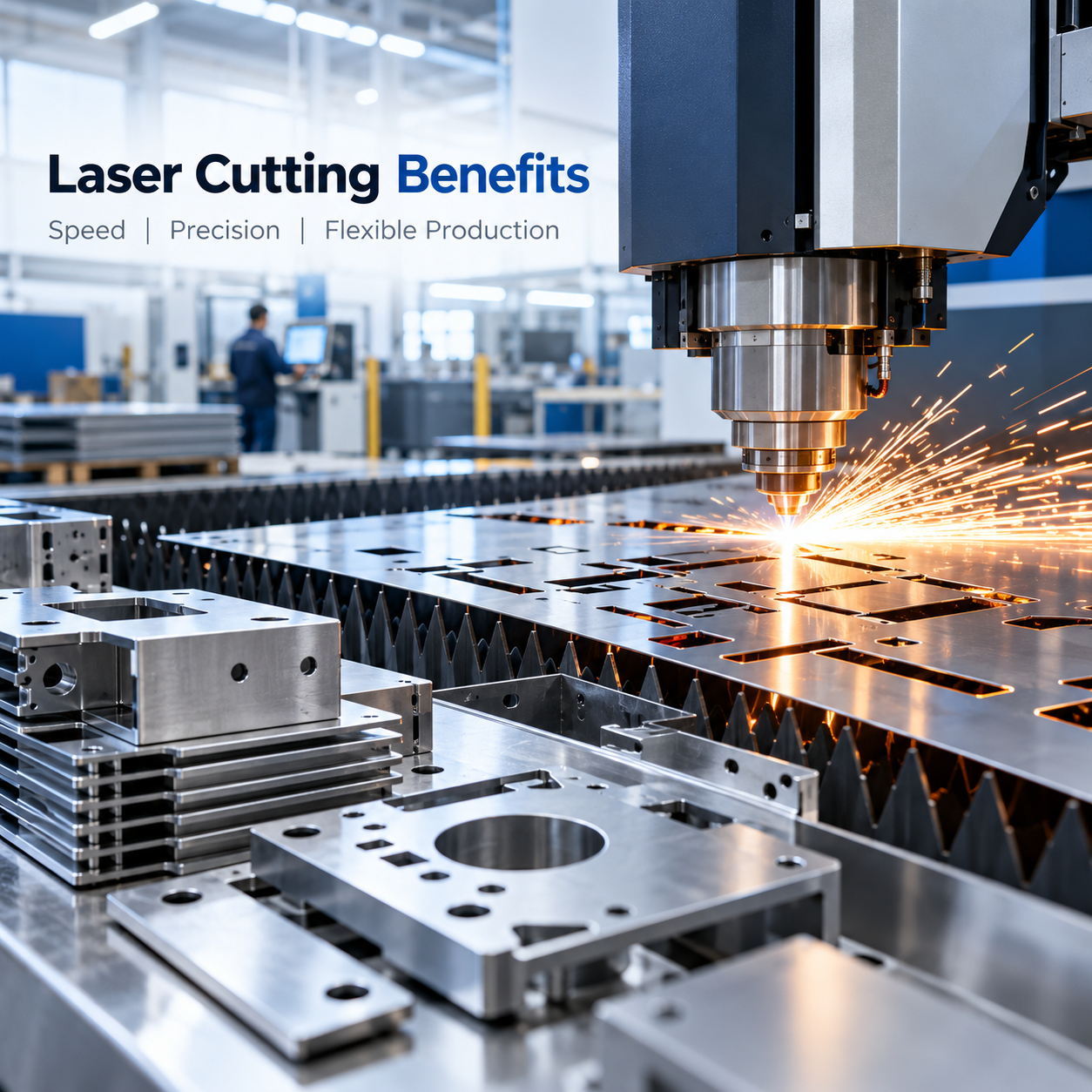
A fast cutting head is only useful if good parts come off it on time. Buyers comparing laser cutting with stamping, sawing, or plasma often focus on speed first. In practice, the stronger case for laser cutting is the combination of short setup, flexible geometry, repeatable CNC control, and fewer tool-related delays—when the part and order volume suit the process.
HDT provides fiber laser cutting for metal, with a listed 6,000 W system and a stated thickness range of 0.5–30 mm. Those are useful starting points, but they do not replace a drawing review. Alloy, part shape, tolerance, batch size, and required edge finish decide whether laser cutting is the economical option.
This guide looks at the shop-floor benefits buyers can actually measure, the conditions behind them, and the information needed to compare laser cutting with another process fairly.
Contents
· Where laser cutting earns its place
· Five practical benefits—and their limits
· Laser cutting versus other process choices
· Case study: faster turnaround for small parts
· How to evaluate total job cost
· A buyer checklist for a clean RFQ
· Frequently Asked Questions
· A practical next step
Where laser cutting earns its place
Laser cutting directs a focused beam along a programmed path. Because the tool does not press against the workpiece, the process can follow complex outlines without a dedicated punch or profile-specific cutting tool. A CNC program controls the geometry, while process settings and assist gas are adjusted for the material and thickness.
This makes laser cutting particularly useful when part designs change, the order includes multiple profiles, or the buyer needs a prototype before committing to dedicated tooling. It is not automatically cheaper for every job. A simple, high-volume part may be better served by stamping or another process once tooling cost is spread across enough units. The comparison needs to include setup, material yield, finishing, and delivery—not just the cutting cycle.
Five practical benefits and their limits
1. Design flexibility without profile-specific tooling
A new outline usually means a revised program rather than a new cutting die. That helps during prototyping and engineering changes, and it makes small or mixed batches easier to manage. The limit is that laser programming and setup still take time; changing a drawing after production begins can create scrap or rework if revision control is weak.
2. Good dimensional control for many sheet-metal profiles
A narrow kerf and CNC motion can produce accurate contours and repeatable features. The actual tolerance must be agreed for the specific part. Thickness variation, heat input, machine condition, nesting, and feature size all affect results. Do not use one advertised accuracy figure as a substitute for a part drawing and an inspection plan.
3. Less mechanical contact with the workpiece
The cutting beam does not wear like a punch or saw blade, and the part is not forced through a mechanical cutting edge. That can reduce tool-change interruptions for varied profiles. It does not mean the process is maintenance-free: protective windows, nozzles, gas supply, extraction, optics, and machine calibration require planned checks under the equipment maker’s instructions.
4. Faster response to design revisions and prototypes
When a revision can be made in the CAD/CAM file, a supplier may move to a new profile without waiting for a die to be manufactured. This is useful for low-to-medium quantities, custom components, and products still moving through design validation. The advantage shrinks when the part is stable and order volume makes dedicated tooling highly productive.
5. Nesting can improve material utilization
Nesting software arranges part profiles on a sheet to reduce unused gaps. The gain depends on the shape mix, grain direction, edge margins, defect zones, and whether remnants can be stored and reused. A supplier should report material yield against the buyer’s actual part mix; “automatic nesting” by itself does not guarantee a particular percentage of savings.
Automation can also reduce manual handling and help keep repeat orders consistent. But the cutting process is one part of the production route. Sorting, deburring, bending, welding, inspection, packaging, and shipping can become the new bottleneck if they are not planned alongside the laser.
Laser cutting versus other process choices
The right process depends on the job. This comparison is intentionally practical: it shows the questions a buyer should ask rather than declaring a universal winner.
Decision factor | Laser cutting | Stamping / punching | Plasma cutting |
Setup investment | Low profile-specific tooling; programming still required | Die or punch tooling can add upfront cost | Low dedicated tooling for many profiles |
Design changes | Usually handled through CAD/CAM revision | Tool change or new die may be required | Program and setup changes are often possible |
Best-fit order profile | Prototype, varied parts, and changing designs | Stable designs and larger repeat volumes | Thicker conductive metals and suitable tolerance needs |
Edge and detail | Fine features are possible within process limits | Good repeatability with suitable tooling | Kerf and heat-affected edge need evaluation |
Cost comparison | Include gas, cutting time, yield, and finishing | Amortize tooling over the run volume | Include edge cleanup, tolerances, and downstream work |
For HDT’s listed laser service, metal thickness is shown as 0.5–30 mm. If a design is near either end of that span, ask for a technical review rather than assuming the full thickness range applies to every alloy, contour, and tolerance. A sample or first article helps resolve questions that a machine specification cannot answer.
Case study: faster turnaround for small parts
The Shim Shack, a U.S. sheet-metal shop, needed a better way to cut very small, thin shims while handling urgent custom requests. In an IPG Photonics published case, the company selected a compact fiber laser cutting system designed for small metal parts. The shop reported cutting hundreds of small parts per hour and shortening some turnaround from weeks to days.
The case shows why throughput is not simply a question of maximum feed rate. The smaller machine footprint, fit with the company’s product mix, and the online path from customer design to cutting file helped make fast custom work practical. The shop later installed multiple systems and adjusted its workflow around them.
Those results belong to The Shim Shack’s equipment, parts, and operating model; they are not a forecast for another factory. A buyer should ask for a representative sample, confirm the smallest feature and material thickness, and measure the complete order cycle—including programming, inspection, and packing.
How to evaluate total job cost
A quote based only on machine minutes can hide the cost drivers that affect a delivered part. Compare the full route: material purchased, usable yield, programming and setup, cutting, secondary finishing, inspection, packaging, and freight. For repeat orders, include how remnants are tracked and whether the approved program and revision will be retained.
Laser cutting may reduce or remove die costs, but it still has process costs. Assist gas, protective consumables, power, operator time, and maintenance all contribute. The price of a job also depends on part count per sheet, cut length, pierce count, small-feature complexity, and how the parts are separated and handled.
A fair comparison asks each supplier to quote the same revision, grade, thickness, quantity, tolerance, finish, and delivery terms. If one quote includes deburring and another does not, the unit prices are not directly comparable. For a design that is still changing, include expected engineering revisions and separate prototype pricing from production pricing.
A buyer checklist for a clean RFQ
Before sending a request, gather the details that influence both feasibility and price:
· Latest 2D drawing and neutral CAD file, with revision identifier
· Material grade, thickness, finish, coating, and grain direction if relevant
· Critical dimensions, tolerances, and acceptable edge condition
· Order quantity, annual demand, delivery schedule, and destination
· Required deburring, bending, welding, coating, or assembly after cutting
· Whether a sample, first-article report, or inspection record is required
A clear acceptance plan prevents “good enough” from meaning different things to the buyer and supplier. Identify which dimensions are checked, how burrs are judged, and whether the parts will be tested in a downstream assembly. If the drawing is still under revision, mark it clearly so obsolete files do not enter production.
Frequently Asked Questions
Is laser cutting cheaper than stamping?
It can be for prototypes, low volumes, or designs that change often because profile-specific tooling may be avoided. For a stable, high-volume part, stamping can become more economical after tooling is amortized. Compare total delivered cost at the real order quantity.
Does laser cutting eliminate secondary finishing?
Not always. Some cuts meet the required edge condition directly; others need deburring, oxide removal, or surface preparation. State the required finish on the drawing and confirm it on a sample.
How much material can nesting save?
There is no universal percentage. Savings depend on part geometry, sheet size, margins, grain direction, and reuse of remnants. Request a yield estimate based on the actual part mix and material specification.
What information helps an HDT laser cutting quote move faster?
Send the latest drawing and CAD file, material grade and thickness, quantity, critical tolerances, edge requirements, downstream operations, and delivery location. HDT’s website invites customers to submit drawings or specifications for a detailed quote.
A practical next step
Laser cutting is most valuable when its flexibility solves a real production problem: a changing design, a mixed batch, a short prototype cycle, or a profile that would otherwise need dedicated tooling. Send HDT your drawing, material, quantity, and edge requirements for a project-specific review and quote.