August 7, 2026
How to Choose Materials for Precision Sheet Metal Fabrication
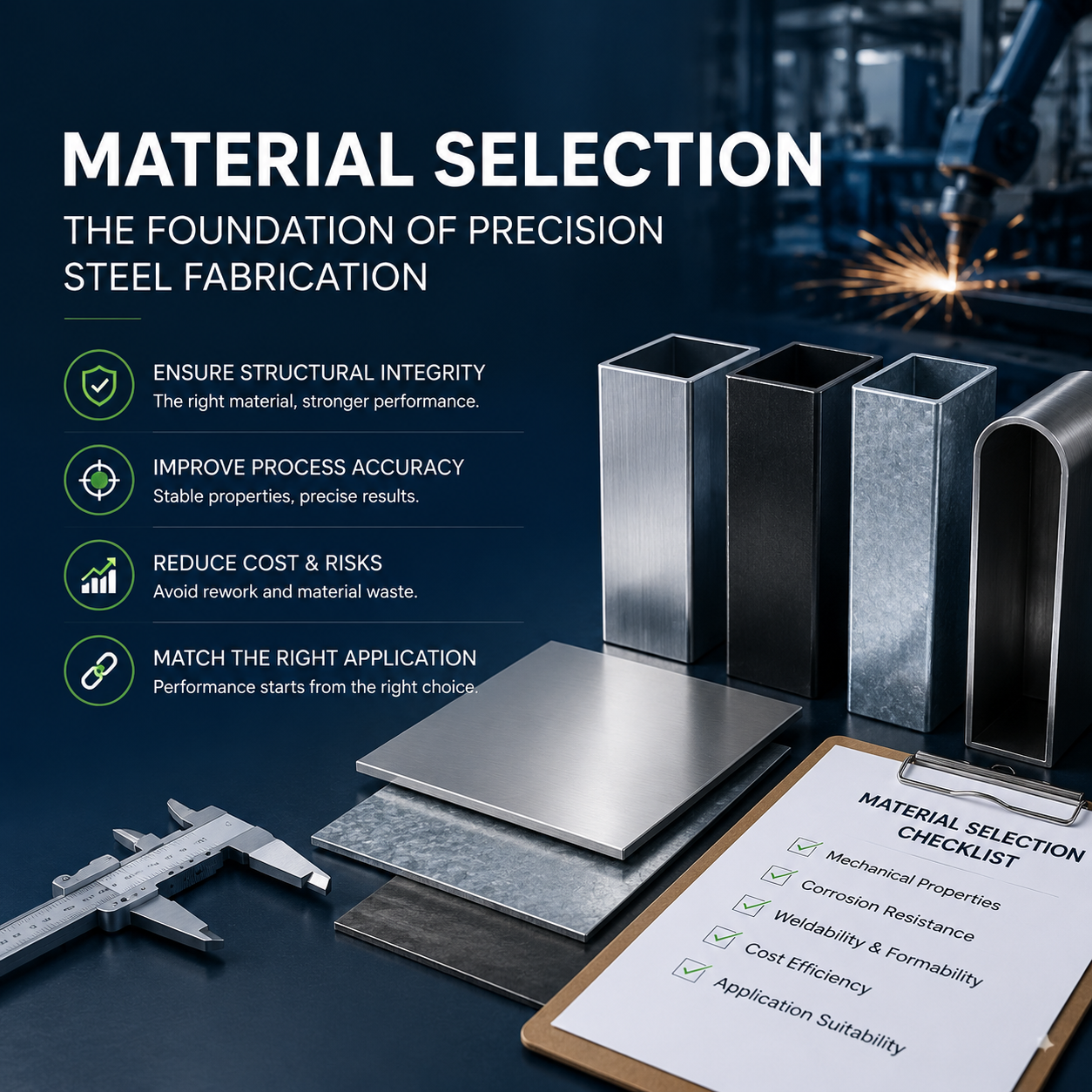
Selecting the right material is one of the most important decisions in precision sheet metal fabrication.
Material choice affects strength, formability, corrosion resistance, electrical conductivity, appearance, welding performance, surface treatment, production cost, and service life. A material that performs well in one application may create unnecessary cost or manufacturing difficulty in another.
For example, a cold-rolled steel enclosure may be economical and easy to form, but it will usually require painting or plating for corrosion protection. Galvanized steel may provide better corrosion resistance, while aluminum reduces weight and stainless steel offers a durable exposed finish.
The correct decision must consider more than material price. Engineers and buyers should evaluate the complete product requirement, including the manufacturing process and the environment in which the finished component will operate.
Table of Contents
· Why Material Selection Matters
· Key Factors in Sheet Metal Material Selection
· Cold-Rolled Steel
· Hot-Rolled Steel
· Electro-Galvanized and Hot-Dip Galvanized Steel
· Copper and Copper Alloys
· Aluminum Sheet and Aluminum Extrusions
· Stainless Steel
· Material Comparison Table
· Sheet Metal Flat Pattern and Bending Considerations
· HDT’s Material Processing Capabilities
· Frequently Asked Questions
· SEO Metadata
Why Material Selection Matters
A sheet metal component is rarely selected according to strength alone.
A control cabinet may require corrosion resistance, electrical continuity, surface appearance, and reliable grounding. An automotive bracket may need fatigue resistance, weldability, and controlled dimensional accuracy. A medical or laboratory enclosure may require a clean surface that is easy to maintain.
The selected material influences almost every later process:
· Laser cutting speed
· Tool wear
· Minimum bend radius
· Springback
· Welding method
· Surface treatment
· Assembly method
· Part weight
· Final appearance
· Overall cost
Poor selection may lead to cracking during bending, unstable welding, coating failure, excessive weight, or unnecessary material expense.
Key Factors in Sheet Metal Material Selection
Before choosing a grade, the project team should review the following questions:
1. What load will the component carry?
2. Will it be used indoors or outdoors?
3. Does it need corrosion protection?
4. Will it be welded, bent, machined, or riveted?
5. Is electrical or thermal conductivity required?
6. Is appearance important?
7. What surface treatment will be applied?
8. What tolerance and flatness are required?
9. Is weight a design concern?
10. What is the target production volume?
The best material is not always the strongest or most expensive option. It is the material that meets the functional requirement while remaining practical to manufacture.
Cold-Rolled Steel
Cold-rolled steel is widely used in precision sheet metal fabrication because it offers a relatively smooth surface, good dimensional control, reliable formability, and competitive cost.
SPCC is a common JIS designation for cold-reduced carbon steel sheet. It is frequently used for electrical enclosures, equipment panels, covers, brackets, office equipment, and painted components.
Cold-rolled steel is particularly suitable for:
· CNC punching
· Laser cutting
· Bending
· Spot welding
· MIG welding
· Powder coating
· Electroplating
In many fabrication projects, cold-rolled steel is selected for thinner parts. The original HDT process note identifies thicknesses up to approximately 3 mm as a common application range, although actual availability depends on the steel supplier and relevant standard.
Cold-rolled steel normally requires surface protection when corrosion resistance is important. Powder coating, wet painting, zinc plating, nickel plating, and other finishes may be used according to the application.
SPCC and Q235A are sometimes grouped together in local purchasing documents, but they should not be treated as automatic equivalents. SPCC is a JIS cold-reduced sheet designation, while Q235A is a structural steel grade under a different standard system. Material substitution should always be approved against the engineering drawing and required mechanical properties.
Hot-Rolled Steel
Hot-rolled steel is commonly selected for thicker structures, frames, bases, brackets, and components where a premium cosmetic surface is not the main requirement.
SPHC is a typical JIS hot-rolled steel sheet designation.
Compared with cold-rolled sheet, hot-rolled material may have:
· A rougher surface
· Mill scale
· Wider dimensional variation
· Lower surface finishing quality
· Good suitability for structural applications
The customer’s original process document identifies material thicknesses of 3 mm and above as a common hot-rolled application range. This is a practical manufacturing guideline rather than a universal limitation.
Hot-rolled sheet is often used for flat components and welded structures. Deep drawing or highly cosmetic applications may require a different grade or additional processing.
Before painting, the surface may require descaling, blasting, grinding, pickling, or another preparation method.
Electro-Galvanized and Hot-Dip Galvanized Steel
Galvanized steel provides a zinc-based protective layer that improves corrosion resistance.
Two commonly discussed categories are electro-galvanized sheet and hot-dip galvanized sheet.
Electro-Galvanized Steel
SECC is commonly associated with electro-galvanized cold-rolled steel.
It usually offers a smoother and more uniform surface than many hot-dip galvanized products. This makes it suitable for precision electronics, communication equipment, indoor enclosures, 3C products, and components requiring controlled appearance.
Typical advantages include:
· Smooth surface
· Good bending performance
· Suitable dimensional accuracy
· Useful corrosion protection for controlled environments
· Compatibility with painted or coated assemblies
Hot-Dip Galvanized Steel
SGCC and GI are commonly used terms for hot-dip galvanized steel products.
Depending on coating specification, these materials may provide a heavier zinc coating and stronger protection for outdoor or industrial environments.
Typical applications include:
· Outdoor electrical cabinets
· Equipment housings
· Ventilation ducts
· Industrial covers
· Solar mounting components
· General outdoor sheet metal parts
Coating thickness, spangle, surface quality, bend performance, and welding requirements should be confirmed before ordering. The terms SECC, SGCC, and GI do not by themselves define every property needed for production.
Copper and Copper Alloys
Copper is mainly selected when electrical or thermal conductivity is required.
Common sheet metal applications include:
· Busbars
· Grounding parts
· Electrical contacts
· Conductive connectors
· Heat-transfer components
· Shielding parts
Copper materials may include pure copper, brass, phosphor bronze, and beryllium copper, depending on the required conductivity, elasticity, wear resistance, and mechanical strength.
Possible surface conditions and finishes include:
· Bare copper
· Tin plating
· Nickel plating
· Chrome plating
Copper is more expensive than ordinary steel and requires careful handling because its surface is relatively soft. Fingerprints, scratches, and deformation may affect appearance and assembly.
The grade should be selected according to conductivity, hardness, forming requirement, and plating process.
Aluminum Sheet and Aluminum Extrusions
Aluminum is widely used when low weight, corrosion resistance, thermal performance, or modern appearance is important.
Common grades include 5052, 6061, and 7075, but they have very different forming characteristics.
5052 Aluminum
5052 is commonly selected for sheet metal enclosures, covers, brackets, and formed components.
It provides:
· Good corrosion resistance
· Good formability
· Useful welding performance
· Moderate strength
· Suitability for anodizing and conversion coating
It is often a practical choice for bent aluminum sheet metal parts.
6061 Aluminum
6061 offers higher strength and good machining performance. It is widely used for structural parts, machined components, plates, and frames.
Its bendability depends strongly on temper and thickness. Tight bending may cause cracking, especially in harder tempers, so bend radius and grain direction should be reviewed carefully.
7075 Aluminum
7075 is a high-strength aluminum alloy commonly associated with aerospace and high-performance mechanical components.
It is not normally the first choice for complex sheet metal bending because its high strength reduces formability. It is more frequently used for machined or carefully engineered parts.
Aluminum Extrusions
Aluminum extrusions are useful for equipment frames, electronic chassis, guide rails, machine structures, and complex profiles.
A custom extrusion can reduce assembly steps by integrating several functions into one cross-section. However, complex geometry may make anodizing, plating, and dimensional control more difficult.
Common aluminum surface treatments include:
· Chemical conversion coating
· Decorative anodizing
· Hard anodizing
· Painting
· Powder coating
· Nickel plating
· Silver plating
Nickel and silver plating generally involve more complex preparation and higher cost than standard anodizing.
Stainless Steel
Stainless steel is selected for corrosion resistance, clean appearance, hygiene, temperature resistance, and long service life.
Common surface options include:
· 2B mill finish
· Brushed finish
· Mirror finish
· Bead-blasted or matte finish
A 2B surface is often the most economical option when the original mill finish is acceptable. Brushed stainless provides a directional decorative texture, while mirror polishing generally requires more processing and higher cost.
Stainless steel is used in:
· Medical equipment
· Food-processing equipment
· Laboratory enclosures
· Outdoor cabinets
· Architectural panels
· Industrial machinery
· High-end electrical housings
Compared with mild steel, stainless steel usually has greater springback and may require larger bend radii, stronger tooling, and adjusted bend deduction.
Material Comparison Table
Material | Main Advantages | Common Applications | Important Considerations |
Cold-Rolled Steel | Low cost, smooth surface, good formability | Cabinets, panels, covers, brackets | Usually requires corrosion protection |
Hot-Rolled Steel | Economical for thicker structures | Frames, bases, welded structures | Rougher surface and mill scale |
SECC | Smooth zinc-coated surface | Electronics and indoor enclosures | Confirm coating and appearance |
SGCC/GI | Strong corrosion protection | Outdoor cabinets, ducting, solar supports | Coating may affect welding and bending |
Copper | Excellent conductivity | Busbars and electrical parts | Higher cost and soft surface |
5052 Aluminum | Lightweight and formable | Enclosures and bent aluminum parts | Bend radius and surface protection |
6061 Aluminum | Strong and machinable | Structural and machined components | Hard tempers may crack during tight bending |
7075 Aluminum | Very high strength | Aerospace and precision mechanical parts | Limited formability and weldability |
Stainless Steel | Corrosion resistance and premium appearance | Medical, food, laboratory, outdoor equipment | Higher springback and material cost |
Sheet Metal Flat Pattern and Bending Considerations
Choosing the material is only the first step. The flat pattern must also reflect the actual forming behavior of the selected grade and thickness.
A reliable engineering drawing should address:
· Material grade and thickness
· Thickness tolerance
· Bend direction
· Grain direction where relevant
· Bend deduction or K-factor
· Minimum inside radius
· Burr direction
· Hem and assembly clearance
· Press-fit and riveting direction
· Surface treatment areas
· Critical dimensional tolerances
Material utilization should be optimized during nesting, but saving material should not create an unstable bending or welding sequence.
For hemmed cold-rolled steel parts, the original HDT process note provides starting clearances of approximately 0.2 mm for material thickness up to 2.0 mm and 0.5 mm for thickness above 2.0 mm and up to 3.0 mm. These values should be verified through tooling capability, coating thickness, assembly requirement, and trial production.
For door panels, a long-side-over-short-side hemming arrangement may improve assembly. Aluminum and stainless steel often require larger allowances because of their forming behavior and springback.
Burr direction should be identified on the drawing. During bending, placing the burr toward the inside of the bend can reduce visible damage and lower the risk of edge cracking.
Formed features such as tapped extrusions, self-clinching fasteners, lances, and embossed areas should be shown clearly with direction arrows or sectional views.
For special-angle bending, trial bending is often necessary. The original process note uses an inside radius of approximately R0.5 mm as a starting reference for conventional cold-rolled steel, while aluminum and stainless steel generally require larger radii. Actual values must be determined by grade, temper, thickness, tooling, and bend direction.
HDT’s Material Processing Capabilities
HDT Intelligent Technology provides sheet metal fabrication and precision machining services covering laser cutting, CNC bending, welding, surface finishing, mechanical assembly, CNC milling, CNC turning, and process development.
The company processes materials including aluminum, carbon steel, stainless steel, brass, copper, and specialty alloys.
For custom projects, the engineering review can consider:
· Material grade
· Thickness
· Part geometry
· Tolerance
· Surface treatment
· Production volume
· Assembly method
· Application environment
Providing complete drawings and material requirements at the beginning of a project helps reduce quotation errors, redesign work, and production risk.
Frequently Asked Questions
What is the most economical material for a painted sheet metal enclosure?
Cold-rolled steel is often a cost-effective choice because it provides good formability and a smooth surface. Powder coating or painting is normally added for corrosion protection.
Should outdoor cabinets use galvanized steel or stainless steel?
Both can be suitable. Galvanized steel is often more economical, while stainless steel may provide better long-term corrosion resistance and appearance. The choice depends on exposure, coating specification, service life, and budget.
Which aluminum grade is best for bent sheet metal parts?
5052 is commonly selected because it combines corrosion resistance and good formability. 6061 may also be used, but its temper and bend radius require careful review. High-strength 7075 is generally less suitable for tight bending.
Why must bend deduction be recalculated when the material changes?
Different grades have different strength, hardness, thickness tolerance, and springback. These factors change the developed blank size and the final bend result.
Choose the Right Material for a More Reliable Sheet Metal Project
Successful precision sheet metal fabrication begins with the right material. Cold-rolled steel, hot-rolled steel, galvanized sheet, copper, aluminum, and stainless steel each offer different advantages in strength, formability, corrosion resistance, conductivity, appearance, and production cost.
Material selection should always be evaluated together with part geometry, bending requirements, welding methods, surface treatment, operating environment, and target production volume. Making these decisions early can reduce design changes, prevent forming defects, and improve the performance of the finished component.
HDT processes a wide range of metal materials and supports customers with laser cutting, CNC bending, welding, precision machining, surface finishing, and assembly services. Send HDT your drawings, material requirements, tolerances, finishing specifications, and estimated quantities to receive material selection support, a customized manufacturing solution, or a project quotation.